
24V Truck Battery Systems — DINWEYS Heavy-Duty OEM
DINWEYS 24V starting systems for heavy trucks, semi trailers and buses — series-configured 12V battery pairs from JIS N150/N200 and DIN88/DIN100 lines.
Key Takeaways
- **24V is two 12V batteries in series, not a single 24V unit** — standard for heavy trucks, semi trailers and buses.
- **Half the current for the same power** — that is why 24V systems use thinner, lighter conductors than 12V.
- **Replace the pair together, same model and batch** — mixing one new and one old battery unbalances charging and shortens the weaker one.
- **Common pairs are 2× N200 (190H52) or 2× DIN100 (60038)** — matched at the factory for balanced charging.
- **Never pair two batteries with different CCA or capacity** — the bank’s output is locked to the weaker unit.
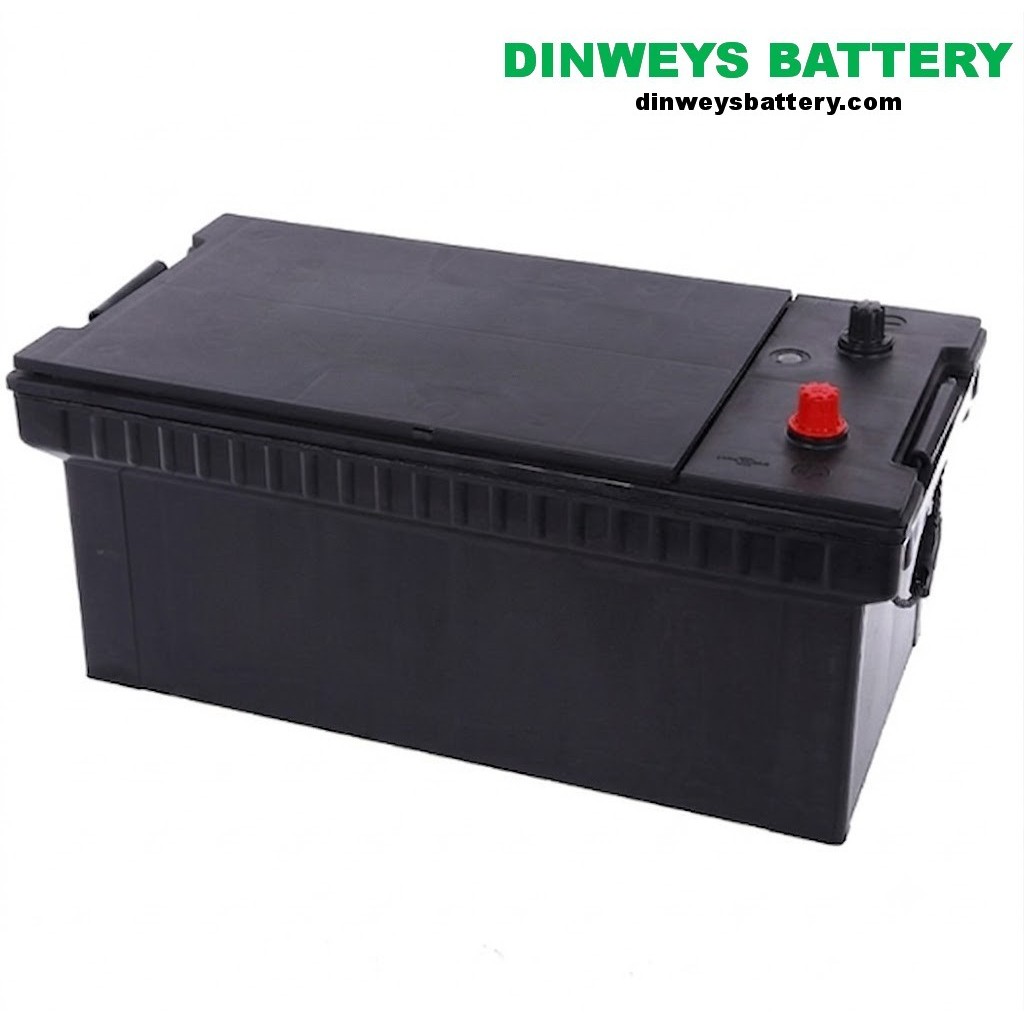
Heavy trucks, buses and semi trailers run on 24V electrical systems — two 12V batteries wired in series. The 24V architecture halves the current for the same power, allowing thinner wiring and more reliable cranking of large diesel engines.
In a 24V system, the two batteries charge and discharge as a single unit, which means they must be treated as a matched pair. Always replace both together, with the same model, age and rating. Replacing only one battery in a series pair causes imbalance and shortens the life of both.
DINWEYS supplies the 12V heavy-duty batteries that build 24V systems — the JIS 145G51/190H52 and DIN 58827/60038 — along with guidance on correct series wiring and charging.
Specifications
| Specification | Value |
|---|---|
| Indicative minimum unit price | From US$80 per unit — final pricing confirmed on quotation (quantity, market and OEM terms apply) |
| System Voltage | 24V (two 12V batteries in series) |
| Common Pairs | 2× JIS 190H52 (N200) / 2× DIN60038 (DIN100) |
| Application | Heavy trucks, semi trailers, buses |
| Matching | Batch-matched pairs for balanced charging |
| Technology | Flooded / EFB / AGM |
Specifications are representative for this model. Exact CCA, capacity and dimensions are confirmed per batch on the certificate of analysis — contact us for a full datasheet.
Understanding These Specifications
Why 24V: a 24V system is two 12V batteries in series, doubling voltage so the same cranking power flows at half the current. Lower current means thinner, lighter wiring and less voltage drop — the reason heavy trucks, buses and semi trailers standardized on 24V.
Matched pairs: the two batteries in a series pair must be identical in model, age and rating. If one is weaker, the pair charges unevenly and both fail early. Always replace a 24V pair together, with two identical batteries.
Charging: use a charger rated for 24V, or charge each 12V battery individually. A 12V charger applied across a 24V series pair will not bring it to a full charge.
Model Comparison
| Aspect | 12V system | 24V system |
|---|---|---|
| Voltage | 12V | 24V (two 12V in series) |
| Current for the same power | Higher | Half |
| Wiring | Thicker conductors | Thinner, lighter conductors |
| Typical vehicles | Light trucks, pickups, medium trucks | Heavy trucks, semi trailers, buses |
| Batteries | One 12V (e.g., N150/N200, DIN88/DIN100) | Two matched 12V in series |
Typical Applications
- Semi trucks and heavy haulers
- Buses and coaches
- Military and specialty vehicles
Application Scenarios in Detail
Semi trucks and heavy haulers
Line-haul tractors run 24V so the starter gets maximum torque with manageable current. Two N200 (190H52) batteries in series provide the cold-cranking reserve a large diesel needs on a cold morning.
Buses and coaches
24V supports the heavy electrical loads of a modern coach — lighting, HVAC, doors and telematics — while keeping conductor sizes practical across the chassis.
Military and specialty vehicles
24V is common in military and specialist vehicles for the same reasons: cranking power, load capacity and standardized components that simplify fleet maintenance.
Maintenance & Care
Always replace both batteries in a 24V pair together with identical models.
Keep terminals clean and tight on both batteries — a single poor connection unbalances the pair.
Use a 24V charger, or charge each 12V battery separately with a 12V charger.
Match battery technology — do not mix flooded and AGM in the same series pair.
Frequently Asked Questions
Why do heavy trucks use 24V?
24V systems halve the current for the same power, allowing thinner wiring and more reliable starting of large diesel engines.
Can I replace one battery of a 24V pair?
It is strongly recommended to replace both batteries as a matched pair to ensure balanced charging and full service life.
How do I wire two 12V batteries for 24V?
Connect the positive terminal of one battery to the negative terminal of the other; the remaining terminals provide 24V across the pair.
Do 24V batteries need a special charger?
Yes. Use a charger rated for 24V, or charge each 12V battery separately with a 12V charger.
What CCA do 24V truck systems need?
Heavy 24V trucks typically need 850–1100+ CCA per battery, depending on engine size and climate. Confirm the exact figure in your vehicle manual.
What happens if I mix an old and a new battery in a 24V pair?
The pair charges unevenly: the stronger battery is overcharged and the weaker one undercharged, shortening the life of both. Always use two identical batteries of the same model, age and rating.
Can I jump-start a 24V truck from a 12V vehicle?
Not directly across the full 24V system. Jump-start procedures for 24V systems vary by vehicle; follow the OEM procedure, and if unsure, charge each 12V battery individually or call a professional.
Do 24V systems use a single 24V battery?
Most heavy trucks use two 12V batteries in series rather than a single 24V unit, because 12V batteries are more widely available and each can be serviced or replaced individually. Dedicated 24V monobloc units exist but are less common in trucks.
Explore Other DINWEYS Product Lines
Related Technical Documentation
From the DINWEYS Knowledge Hub.
Technical review — Reviewed by the DINWEYS technical team. Manufacturer: Chengguang Power Tech Co., Ltd. Data source: manufacturer specification and test documentation. Specifications vary by model and standard; confirm final values with the manufacturer.